 EN
EN  DE
DE 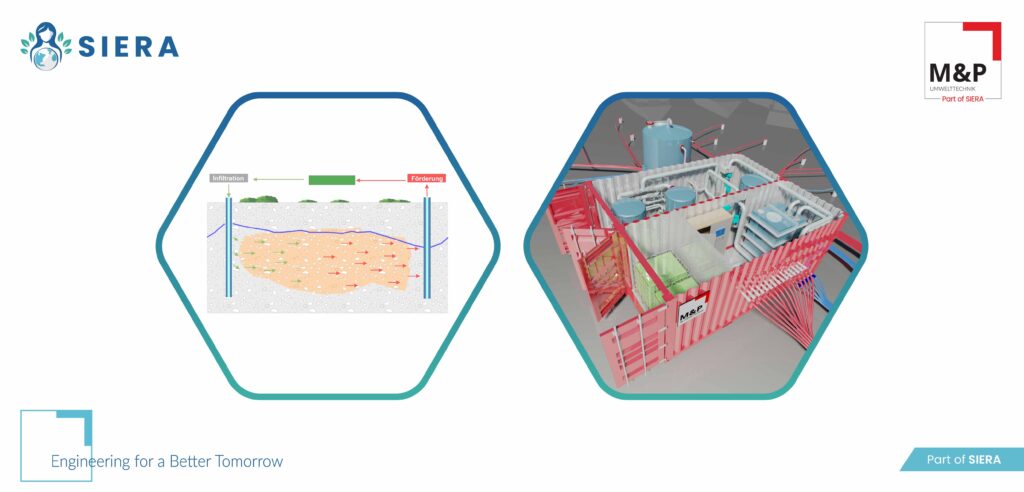
Modular groundwater remediation for a complex case of damage in Hesse
The remediation of contaminated soils and aquifers poses major technical and regulatory challenges for industrial companies and authorities alike. Sophisticated, reliable and flexible solutions are required, especially when pollutants have already entered the subsoil and further spread via the groundwater flow must be prevented. This is precisely where a current project being planned and realised by M&P Umwelttechnik GmbH - a member of the SIERA Alliance - on an industrial site in Hesse comes in. Under the motto „Engineering For A Better Tomorrow“ this project shows how modern environmental technology and precise planning go hand in hand.
Initial situation: Pollutants in the soil and groundwater
Pollutants were detected in the soil and groundwater at an industrial site in Hesse. One of the main objectives of the remediation measure is to prevent these pollutants from being transported away with the natural groundwater flow. An uncontrolled spread would not only have ecological consequences, but could also jeopardise neighbouring uses and protected assets.
With this in mind, M&P Umwelttechnik GmbH - a member of the SIERA Alliance - was commissioned with the planning and construction of a new groundwater remediation plant. Even in the early project phase, the focus was on making the plant as compact as possible without compromising on efficiency, controllability or operational safety.
Selection of the appropriate reorganisation procedure
As part of a comprehensive variant study, different remediation methods were analysed for the present case of damage. The aim of this study was to identify the most technically and economically suitable method.
As a result of this evaluation, a Microbiological in-situ process emerge. This process enables the reduction of pollutant concentrations directly underground. In many cases, groundwater remediation of this kind can therefore be carried out without the need for large above-ground systems.
A key advantage of this approach is that:
- the actual pollutant reduction takes place underground,
- only comparatively small above-ground facilities are required,
- interventions in the ongoing operation of the industrial site can be minimised.
Compact and modular system design
Based on the selected process, M&P Umwelttechnik GmbH is planning a new, compact groundwater remediation plant. A central planning element is the Modular design of the system.
The modular system offers decisive advantages for subsequent operation:
- High flexibility: If the volume flow is reduced, individual parts of the system can be taken out of operation.
- Unchanged process steps: Despite adjustments to operations, the basic process steps of the refurbishment remain unchanged.
- Optimised controllability: The renovation can be adapted to the progress of the subsoil.
This modular concept makes a significant contribution to ensuring the efficiency of the programme over its entire duration.
Choice of location and infrastructural boundary conditions
Another important aspect of planning concerns the installation location of the system. In order to achieve a Easy accessibility for operation and maintenance the plant is to be erected outside the actual company premises.
However, this decision entails additional technical requirements. Among other things, it must:
- one of the main roads on the farm must be crossed,
- the cable routing must be designed to be safe and durable.
In addition, the Weather conditions must be taken into account. Both periods of frost in winter and high temperatures with strong solar radiation in summer are taken into account when designing the system. The aim is to ensure stable and safe operation all year round under changing climatic conditions.
Pumping tests as the basis for the design
Extensive pumping tests were carried out prior to the actual planning stage. These provided important findings for the dimensioning and design of the rehabilitation system.
The pump tests provide information about:
- the optimum groundwater abstraction rates,
- the appropriate infiltration rates,
- the scope of the measure underground.
The trials have been recognised as Immission pumping tests (IPV) executed. The aim of this method is to localise the current location of the source of the damage as precisely as possible. This information is crucial for targeted and effective remediation.
Monitoring, analytics and continuous optimisation
A comprehensive monitoring concept is planned to ensure the efficiency of the system and compliance with all regulatory requirements.
During operation, regular:
- Groundwater samples,
- Samples after defined process steps
extracted and analysed.
The analysis data obtained forms the basis for a Continuous adjustment of the process parameters. In this way, the operation of the system can be continuously adapted to the progress of the refurbishment and further optimised.
Overview: Key project features of groundwater remediation
| Project feature | Description of the |
| Location | Industrial sites in Hesse |
| Procedure | Microbiological in-situ process |
| System concept | Compact and modular |
| Special features | Installation outside the company premises, crossing a main road |
| Preliminary examinations | Immission pumping tests (IPV) |
| Operation | Regular sampling and adjustment of process parameters |
Contribution to sustainable environmental technology
With the planning and construction of this groundwater remediation plant, M&P Umwelttechnik GmbH is making an important contribution to the sustainable remediation of contaminated sites. The project is an example of how technical precision, modular concepts and detailed preliminary investigations can work together to efficiently and controllably remedy complex environmental damage.
M&P Umwelttechnik - a member of the SIERA Alliance - stands for innovative solutions in environmental technology and consistently pursues the goal of „Engineering For A Better Tomorrow“.